
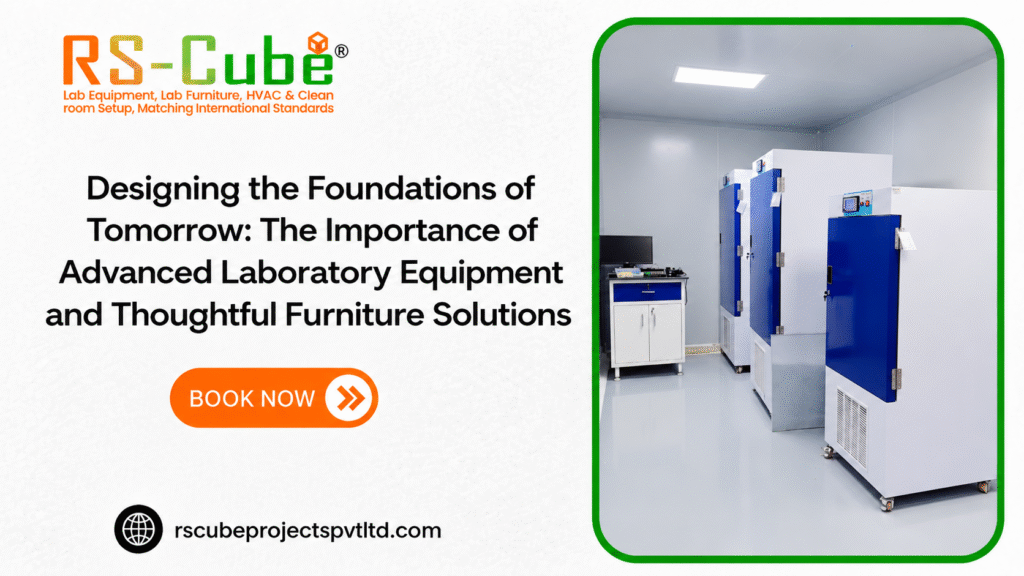
As science continues to reshape the modern world, the expectations from laboratory environments are also evolving. Today’s laboratories need infrastructure that understands the demands of advanced research, supports the discipline of experimentation, and provides a dependable foundation for everyday scientific activities. From educational institutions and diagnostic centres to pharmaceutical industries and specialised research facilities, the need for reliable equipment and intelligently designed furniture has become an essential part of scientific development.
Creating such an environment requires more than assembling products. It demands an understanding of how people work, how scientific processes function, and how every element of a laboratory can contribute to better outcomes. This is the philosophy that defines RS CUBE, where the importance of functional laboratory infrastructure meets the vision of creating spaces prepared for the discoveries of tomorrow.
A thoughtfully equipped laboratory does more than simplify daily operations; it gives researchers, students, and professionals an environment in which they can concentrate on what truly matters — exploring possibilities, finding answers, and turning knowledge into progress. From selecting appropriate equipment to planning durable and practical furniture, every decision becomes a building block in the journey towards scientific excellence.
Every remarkable discovery has its origin. It might spark from a question that dares to defy the ordinary, or from an experiment that unlocks a world of new possibilities. But at the heart of every scientific triumph is an environment that fuels exploration. A laboratory is far more than a collection of instruments and workstations. It is a thoughtfully crafted space where curiosity meets discipline, knowledge becomes insight, and even the smallest observation can spark extraordinary breakthroughs.
In today’s fast-paced scientific landscape, laboratories are called upon to be much more than simple workspaces. They must inspire precision, ensure safety, enable smooth operations, and respond flexibly to the ever-shifting needs of research and technology. Whether in schools, hospitals, pharmaceutical companies, research hubs, or testing labs, every scientific setting thrives on careful planning and reliable infrastructure.
This is where RS CUBE sharpens its vision. Recognizing how vital laboratory infrastructure is to scientific progress, the brand is dedicated to crafting functional, organized, and expertly designed spaces. RS CUBE’s philosophy is clear: meaningful science flourishes on a foundation of quality, practicality, and meticulous attention to detail.
Understanding the Importance of a Reliable Laboratory Equipment Supplier in Modern Scientific Environments
Science moves forward on the strength of precision whether researchers are decoding intricate chemical reactions, examining biological mysteries, testing materials, or venturing into new medical frontiers, the calibre and fit of laboratory equipment shape every step of their journey.
Selecting a trustworthy laboratory equipment supplier is a pivotal choice for any institution that prizes accuracy and efficiency. Equipment should do more than fill a room; it should streamline workflows, ensure reliable results, and foster a safer environment. Each laboratory is unique, and recognizing these distinctions is key to choosing the best solutions.
A well-equipped laboratory weaves together essential instruments, smart storage, sturdy work surfaces, safety features, and specialized accessories. Every piece should serve a clear purpose and enhance the harmony of the entire space.
In educational labs, equipment should spark hands-on learning and help students grasp science through real experience. Research labs demand reliable tools for deep investigations and repeated trials. Industrial and pharmaceutical labs, on the other hand, often require tailored setups that ensure controlled processes and steady results.
A professional supplier knows there is no one-size-fits-all answer. True guidance starts with understanding the work, the space, daily demands, and the institution’s long-term vision.
The Art and Science of Creating Functional Laboratory Furniture
A laboratory’s physical environment shapes how people work. Furniture layout guides movement, boosts accessibility, fosters organisation, and ensures comfort for everyone inside. When space is designed with care, daily routines flow with structure and efficiency.
Laboratory furniture must be built for purpose. Unlike ordinary office pieces, it must handle specialized equipment, withstand frequent cleaning, endure tough conditions, and support unique laboratory tasks.
Workbenches, storage cabinets, instrument tables, sinks, and wall units all help shape a well-organized scientific space. Choosing them means weighing material quality, strength, size, upkeep, and how well they fit the lab’s needs.
An efficiently designed laboratory also minimizes unnecessary movement. Frequently used equipment should remain accessible, storage should be organized around operational needs, and work areas should allow laboratory professionals to perform their responsibilities comfortably.
Such thoughtful planning creates more than an attractive interior. It establishes an environment where efficiency and safety become part of everyday practice.
Why Choosing the Best Laboratory Furniture Supplier Makes a Lasting Difference
The foundation of an effective laboratory is not determined by appearance alone. It is built on the quality of its infrastructure and the suitability of every component.
Choosing the best laboratory furniture supplier means seeing past what’s in stock and weighing the full value: thoughtful design, quality materials, smart functionality, and expert support.
Laboratory furniture must be tough enough for its environment. Some labs need surfaces that resist moisture, chemicals, heat, or constant cleaning. That’s why material choices should always match real-world use and safety needs.
A knowledgeable supplier helps institutions understand these needs and find furniture that fits their unique environment. This guidance is especially valuable when building new labs or refreshing old ones.
Smart furniture arrangement makes the most of every inch. Even a small lab can boost productivity when workstations, storage, and equipment are thoughtfully placed.
For institutions building for the future, picking the right lab furniture is more than a purchase. It’s an investment in the daily lives of researchers, students, technicians, and scientists.
Essential Qualities That Define a Well-Planned Laboratory
Lab efficiency comes from blending smart design with real-world function. Each element should serve a bigger purpose, not just stand alone.
Some important considerations include:
- Material Quality and Durability: Select laboratory furniture and equipment based on the environmental conditions and activities they are expected to support.
- Safety and Accessibility: Proper layouts, suitable storage, and accessible workstations help create a more organized working environment.
- Space Optimization: Smart layouts make it easier to accommodate essential equipment without overcrowding key work areas.
- Long-Term Functionality: Adaptable infrastructure allows laboratories to respond to changing requirements and future developments.
These principles turn an ordinary room into a space where science thrives, focus sharpens, and progress never stops.
How Modern Laboratory Infrastructure Supports Scientific Progress
The future of science rests not just on breakthroughs, but on the spaces that make them possible. As research evolves, labs need to flex and grow, welcoming new tools, technologies, and specialized uses.
Modern lab planning means seeing how every activity fits together in one space. Equipment layout, power needs, ventilation, water, storage, and safety all come together in a single, unified design.
A thoughtfully developed laboratory can support better organisation, minimize avoidable disruptions, and create a more comfortable working atmosphere. It also helps institutions use their available resources more effectively.
The growing importance of research and development across healthcare, education, biotechnology, pharmaceuticals, and industrial testing makes dependable laboratory infrastructure more valuable than ever.
Through its focus on laboratory solutions, RS CUBE reflects the importance of combining practical requirements with a forward-looking understanding of scientific spaces. The objective is to recognise that every laboratory has a purpose, every workstation has a responsibility, and every infrastructure decision contributes to the larger pursuit of knowledge.
What Institutions Should Consider Before Choosing Laboratory Solutions
Choosing lab equipment and furniture starts with knowing what you need now and what you’ll need tomorrow. Before investing, institutions should weigh several key factors.
- Nature of Laboratory Activities: Identify whether the facility is intended for educational experiments, chemical analysis, medical testing, industrial research, or specialized scientific applications.
- Available Space and Layout: Assess the dimensions, movement requirements, storage needs, and placement of essential utilities.
- Safety and Material Compatibility: Ensure selected products suit the chemicals, temperatures, cleaning procedures, and working conditions involved.
- Maintenance and Future Expansion: Consider ease of maintenance, replacement requirements, adaptability, and the possibility of expanding laboratory operations.
These considerations help decision-makers develop a more practical purchasing strategy and avoid infrastructure choices that may create difficulties later.
Building the Laboratories of Tomorrow Through Quality and Purpose
A laboratory is ultimately a place where possibilities meet reality. It is where students discover their potential, researchers challenge existing knowledge, and professionals work towards solutions that can improve everyday life.
Behind every achievement is an environment that stays reliable, organized, and ready for what’s next. Furniture should support the work, equipment should serve its purpose, and infrastructure should unite every element in harmony.
Choosing the right laboratory solutions is therefore an important step towards creating spaces that encourage innovation while maintaining the discipline that scientific work demands.
RS CUBE understands how crucial this foundation is and how reliable lab infrastructure supports today’s science. By putting function, planning, and practicality first, RS CUBE envisions spaces built for both today’s experiments and tomorrow’s breakthroughs.
Because every great scientific achievement deserves a space where it can take root, flourish, and reach its highest potential.
Faq
Q1. What are the different types of laboratory furniture?
A1. Common types include laboratory workbenches, instrument tables, storage cabinets, wall-mounted cabinets, sink units, reagent racks, and specialised workstations.
Q2. Why is laboratory furniture different from regular office furniture?
A2. Laboratory furniture is designed for specialised working conditions. It may require chemical-resistant surfaces, stronger structures, easy-to-clean materials, and compatibility with laboratory equipment.
Q3. How does laboratory furniture improve workplace efficiency?
A3. Properly designed furniture improves space utilisation, keeps essential materials accessible, supports organised workflows, and reduces unnecessary movement during laboratory activities.
Q4. Which industries require professional laboratory equipment?
A4. Educational institutions, hospitals, pharmaceutical companies, biotechnology organisations, chemical industries, food testing facilities, and research centres commonly require laboratory equipment.
Q5. What factors should be considered when setting up a new laboratory?
A5. Important factors include laboratory purpose, available space, equipment requirements, furniture layout, ventilation, electrical connections, water supply, storage, and safety standards.